
Digging through Databases: Discovering Canadiana Across Institutions

By guest author: Andreea Opinca Brant, Digital Heritage Engagement Assistant
https://doi.org/10.82389/8px3-qt96
For the final semester of my master’s program, I was welcomed to the CRKN team to complete a practicum placement and supplement my graduate studies with professional experience. I officially served as Digital Heritage Engagement Assistant, where I contributed to a project examining how the Canadiana and Heritage collections are currently presented on CRKN member institutions' digital library platforms.
Having only navigated my own institution’s research environments, I was excited to embark on this national scan and discover the differing priorities that can emerge surrounding the use of the same resources. Here I have documented the process of discovery, the results of the research, as well as some insights for CRKN moving forward. I also include some of my own reflections from this process, on how this experience will inform my future endeavors as an emerging information professional.
Brief History of the Collections
The histories of the Canadiana and Héritage collections are rich and engaging, just as the materials hosted on the platforms. They are some of the largest digital collections in the world containing digitized Canadian publications and archival records.
Canadiana began as a microfiche collection that preserved Canadian published materials while making them widely available to all Canadians. The collection was eventually digitized and became available online under the name “Early Canadiana Online.” In 2008, the collections were renamed to Canadiana.org to reflect the changes in scope and management. In 2018 Canadiana.org merged with CRKN, and now contain historical publications such as monographs (books), serials (newspapers, magazines, journals, annual reports), government publications, and maps.
Héritage began as a collaborative project between CRKN and the Library and Archives Canada (LAC) in which its archival microfilm collections were digitized. It hosts archival materials such as governmental records, records relating to Indigenous history, genealogical records, military records, and personal papers.
These two collections relate through a shared goal of preserving Canadian cultural heritage but vary in development and content. This has led to the challenge of encountering outdated catalogue records, descriptions, and metadata. My research sought to pinpoint these potential discrepancies to ensure records are updated and accurately describe the current state of the evolving resources .
Research Process
To appropriately understand how each institution represents the digital collections, I analyzed their library websites, and approaches to database discovery. I systematically reviewed each of the CRKN’s members online platforms, specifically looking at how Canadiana and Héritage were presented as resources for research. Most of the approach involved the use of keyword search and attempts to replicate a potential user’s search process through each library platform.
Once the resources were found, I analyzed their metadata. I specifically looked at the name, label, description, and subject elements attributed to each resource, as well as whether institutional access was required through sign-in prompts. This information was documented for each institution, for both Canadiana and Héritage. The research is now being used to guide engagement strategies, and promotion for the shared digital platforms. It will also be useful in promoting the updated infrastructure for Canadiana, which is set to roll out in the near future.
Examples of how databases are made discoverable in digital library platforms
Interesting Discoveries
The descriptive metadata about Canadiana and Héritage tended to vary across institutions. In most cases, appropriate labels and descriptions were given identifying the collections as repositories containing Canadian materials. However, there were instances in which outdated information appeared. For example, the former name for Canadiana, “Early Canadiana Online,” would sometimes come up in searches relating to the platform. In some instances, it was used as an alternate name helping to notify users of the name change.
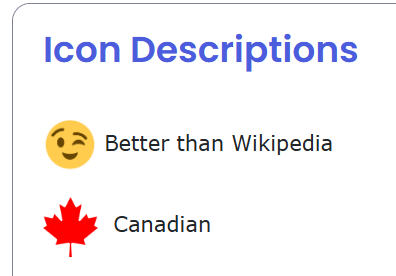
An example of item tags and descriptions that help easily identify some details about resources such as Canadiana

An example of Canadiana's former name, with tags noting Open Access and Alumni Access
There were also instances in which Héritage would not be made available as a resource for research. This did not happen frequently, but it was prevalent enough to question why it was not included. There are many possible reasons for why this happened, but it could be out of a misunderstanding in which Canadiana and Héritage were conflated as one singular digital collection, instead of two separate ones.
Several strong practices emerged across institutions that support effective access to the CRKN collections. One of the most notable was the ongoing discoverability of open access materials. Many institutions clearly identified when resources were open access, and some also created detailed collections of open access materials. Similarly, this was done with materials that were made available for alumni, easily distinguishing what is available for whom.
CRKN is also occasionally acknowledged as a maintenance provider. Identifying CRKN in this way encourages proper attribution while also informing users about the organization behind the collections. This can potentially spark interest in further explorations of CRKN itself, and how these repositories are made accessible through collaborative efforts and collective ownership amongst member institutions.
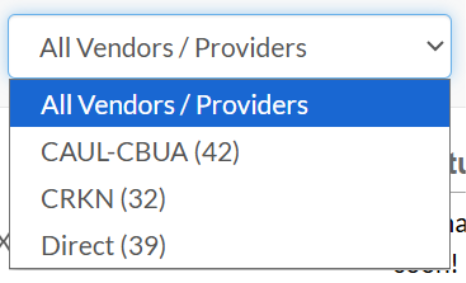
When searching the databases, some institutions include a vendor filter that often includes CRKN
Insights Moving Forward
Conducting this research has also revealed some interesting variations in how resources are presented across institutions. Digital infrastructures vary in structure, depending on institutional goals, and who is present to manage the platforms. While variation is understandable and expected, it does alter how similar resources are experienced by users.
These observations also brought about some questions: Who is responsible for how this information is presented? Should institutions have full control over how they describe materials? Or is a collaborative approach needed, through more active engagement between providers such as CRKN and the institutions they serve?
I don't believe answers are completely straightforward. However, increased coordination could improve consistency and allow institutions to tailor descriptions to their community’s needs.
These questions are more important given the nature of Canadiana and Héritage. These collections are open access, and they are developed through collective stewardship rather than commercial backing. They serve national research efforts that are widely diverse in scope. The collections are also used beyond academic institutions; therefore, it is more critical that they are accessible and intuitive for a variety of user groups.
Reflections as an Emerging Information Professional
Conducting this research on CRKN member’s digital infrastructures has been eye opening in how information is structured, and how access shapes users’ understanding throughout the research process. Most users might only function within one or two academic institutional systems, and they might rarely encounter an alternative platform. As a result, their methods of research are shaped, often unknowingly, by the structure and design of those systems. Resources that are easy to find will likely be prioritized because of their visibility within library platforms.
Taking part in this nationwide review also challenged me to move across numerous platforms, which was difficult at times, but made it easier to expose the variations that can exist in information presentation. It demonstrated to me just how much thought and interpretation goes into organizing information, and how these decisions directly impact a user or researcher’s experience.
As I embark on the next stage of my professional journey, I hope to be able to use what I have learned through my experience with CRKN to inform my approach and future career development. I will carry forward a heightened awareness of how access is structured in whatever role I take on, whether it be through system design or supporting users, and will continually strive to meet the needs of those I work with.

Andreea Opinca Brant (https://orcid.org/0009-0006-5677-586X)
Andreea Opinca Brant is a Master of Information from the University of Toronto, with a concentration Library and Information Science. She joined CRKN in January 2026 as a Digital Heritage Engagement Assistant, through the iSchool’s Information Professional Practicum opportunity (INF2173H). She holds an Honours BA in Book and Media Studies with minors in Digital Humanities and Near & Middle Eastern Civilizations. She hopes to work at the intersection of cultural heritage and digital access to support humanities research, while also making these topics widely accessible and inviting.